Telecritical Care: Part of The Future and The Model Matters


 RSS Feed
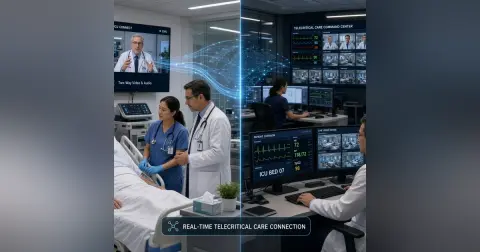
Telecritical care is definitely part of the future of our field. And yet, the literature surrounding telecritical care implementation and outcomes in the ICU is conflicting.
In this episode, Dr. Hassaballa explains how the model of telecritical care implementation makes all the difference in the world.
Hesham A. Hassaballa: This is Healthcare Musings. I'm your host, Dr. Hashem Hasabala. Welcome to Healthcare Meetings, everybody. Happy to have you with me. So last week I attended the Chest 2026 conference because I presented an abstract about telecritical care and its effect on meaningful outcomes in the ICU. It was a rural setting. and I had on the show that week a Dr. Eugene Yeh, one of my partners and collaborators in Sound Critical Care, Teleintensivist, telemedical telemedicine program medical director. For sound critical care, one of my research partners, and he we went over his data for a rural Midwestern hospital where that showed meaningful improvement in outcomes with telecritical care. And then I presented my abstract as well, where in a rural Western United States ICU implementation that a proactive telecritical care model where There was mandatory critical care consultation on patients with mechanical ventilation, vasopressors, and other critical illnesses, where the intensivists rounded, wrote notes, implemented orders, were part of the team in collaboration with on-site hospital medicine colleagues. We demonstrated an improvement in duration of mechanical ventilation by more than 20%, from 3.02 days to 2.38 days. We also showed that prolonged mechanical ventilation, meaning longer than seven days, was decreased by more than half from 17 patients in the baseline period to five patients in the post-tele ICU implementation period. And I think, and this is kind of the focus of what I want to talk about today, and why the the title of the episode is The Model Matters. we were able to decrease. Transfers to a higher level of care outside of the institution from 20 in the baseline period to 10 in the post-telemedicine period. and th this is what I want to focus on really. You know, length of stay is super important. and while we didn't have length of stay for our what Western ICU, for the Midwestern, we did have length of stay data and it improved. And length, you know, length of stay is cost, man, for a hospital. It's cost. For a patient, length of decreased lengths of stay means the sooner they get off the ventilator, the sooner they get out of the ICU, the sooner they get out of the hospital, the sooner they get on the road code to the road to recovery. I'm sorry. For hospital, you know, you get a fixed amount of reimbursement, no matter what the no matter how many diagnoses, no matter what, no matter what is going on with the patient, right? So the sooner they get out of the unit, out of the hospital, the less cost it is and the More financially sustainable the operation of the hospital becomes. So in length of stay is super, super important for a hospital and the patient. Like so when you have decreased length of stay, both patients and hospitals win, right? And we're all in this together. And hospitals are there to care for patients in the community. And so if you get people off of the ventilator and out of the ICU and out of the hospital faster, everyone wins. The hospital wins, the patient wins. And of course, the reason why the hospital is there and we are there as physicians and caregivers and clinicians. Is for the patient. Something that is very important and you can't really capture an outcome data is that metric that we found in the rural Western ICU, decreasing the number of transfers out of that hospital. Now, from a from from a hospital perspective, right? If you were able to offer more critical, more complex services, that revenue is captured by you rather than captured by the hospital to which you send the patient. That's also important, right? So it's not only is decreased cost, but more revenue, right? And if you have good, efficient care, which is what we do, then not only do you capture more revenue, you have decreased cost and then you have more value. From the patient perspective, again, that is it's hard to capture and it's so important. When you're being when you're sick in general, when you're sick, it's miserable, right? You know, I've been sick. I got c I remember having COVID and it was miserable, it was miserable, right? Even though thank God, thank God, I didn't have a really bad illness, it was still miserable. When you're sick, it's bad enough. If you're sick enough to get into the hospital, which on today's age, you gotta be super sick to get into the hospital. So if you're sick, it's miserable. If you're sick enough to be hospitalized, that's even worse, right? The hospital, even though it's necessary. For you to recover from some types of illness, especially critical illness, it's still difficult. It is not a healing environment. The ICU is noisy. It's not necessarily private. there's a lot of loss of dignity. you're poked and prouded, and and it's it's a very difficult thing. And one part of our the the crucial part of our job, they nay let me say, and pun is intended here, the critical part of our job. is to make sure the patient survives critical illness with the least amount of damage long term, right? And that can be very challenging, especially with the sicker the patient is. So being sick and being hospitalized and being critically ill is difficult enough on the patient and the family. Now multiply that difficulty with having now to leave your community and go elsewhere. In the Chicago I know I'm based in Chicago, in the Chicago area, when we had to transfer from the outlying suburbs to the middle of the city, downtown, it was a huge stressor on families because now the the hospital is local to their communities. It's part of the community. It's local. Now they have to travel sometimes an hour or more to visit their loved one. That's very difficult, especially if you're working and you have young children and you carry who's going to take care of the kids. How are we going to get there? that's difficult on the family and when you're hospitalized and you don't have your family there as easily, it's also a big stressor on you, on the pa on the patient, right? The patient's comfort is partly or greatly by the presence of family, familiar family members and and loved ones. So now not having them as often because you're farther away makes a huge difference, right? I was able to help a very, very dear Friend of mine, someone very dear to my heart, help his father be transferred to closer to home. And it was huge for the family because now they can be around their their their dad much closer to home rather than three hours or more away. It's maybe 30 minutes away. And it's a huge difference. So if you're able, by implementing telecritical care on a proactive basis, able to offer more complex services so that patients can stay at the local hospital more often and they can stay in their community, that's huge. That you can't necessarily measure that in an outcome. For that patient and that family, that makes all the difference in the world. and I'm and you know what that that may may be a reason why they they can recover more easily or more or more quickly. because again staying local, staying with your In the local community with your family near you when you're s sick and especially critically ill and trying to recover from critical illness, having that family support is humongous and it can make all the difference in the world. And that's the power of telecritical care. And the model matters. And that's why the literature is all over the place because the model matters. We've dem over and over we've demonstrated that proactive, you know, engaged telemedicine, telecritical care implementation, especially in the rural setting, can improve outcomes, can get you off the ventilator faster, can get you out of the hospital faster, can get you out of the ICU faster. and what's so important, can keep you home near your family. That is huge. And it just depends on the model. The model matters. And when we do it the right way, Telecritical care, which is going to be part of the future of critical care for the foresee for the from now on, the way you do it makes all the difference in the world. Thanks everybody for your time and attention. And I'll see you next time on Healthcare Musings. Thanks for listening. Healthcare Musings is a production of FaithfulWord Media. Sign up at drhasabala.com to get every episode delivered directly to your inbox. And please don't forget to give the show a five-star review. Thanks so much.