Live From CHEST 2026: Dr. Eugene Yeh


 RSS Feed
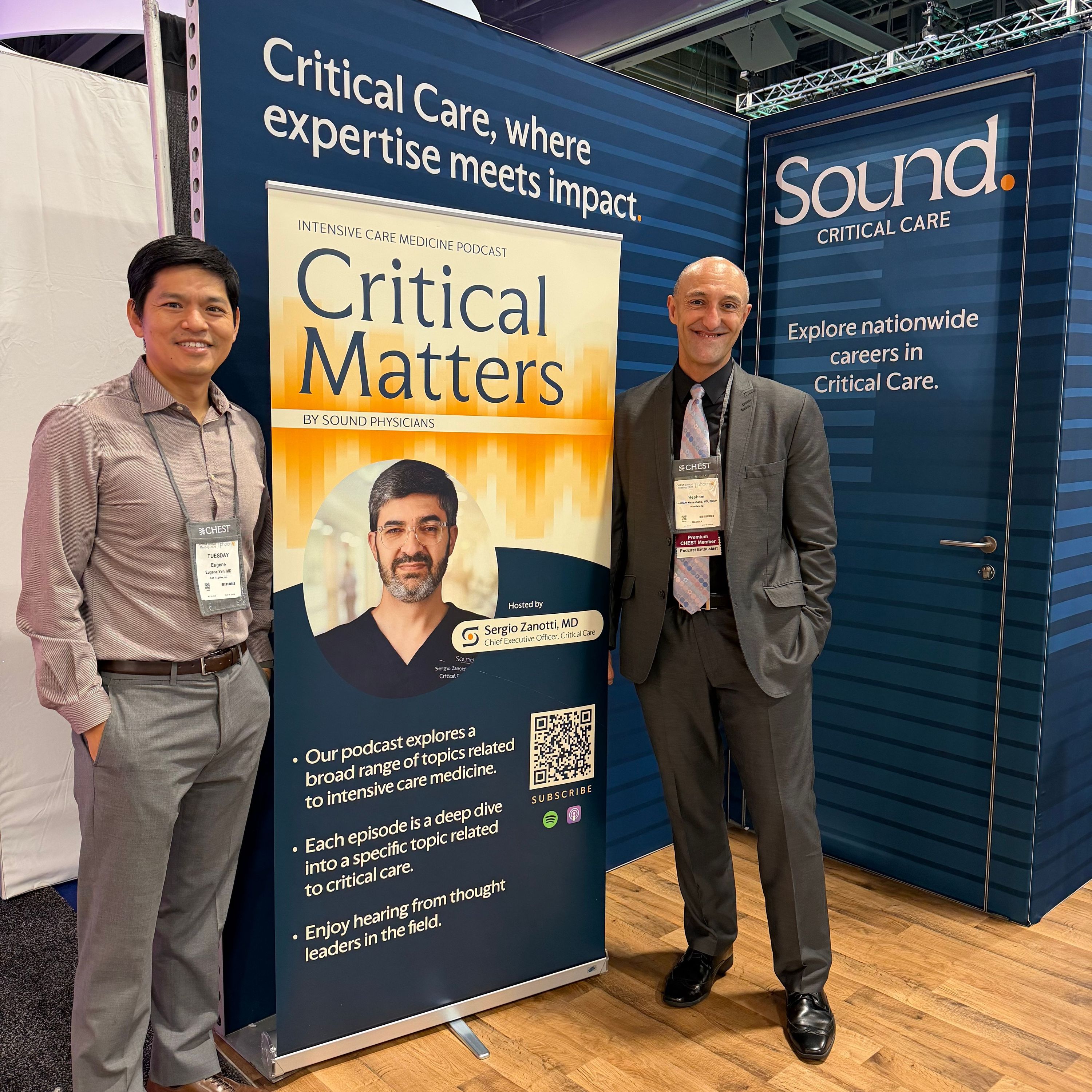
Dr. Eugene Yeh is a telecritical care specialist and program director. I caught up with him at the CHEST 2026 Conference in Phoenix, where we discussed his research showing improved outcomes with a proactive telecritical care model in a rural hospital in the Midwest.
Hesham A. Hassaballa: This is Healthcare Musings. I'm your host, Dr. Hashem Hasabala. Welcome to Help Care Musions, everybody. Happy to have you with me. So I am at the Chess 2026 conference with Dr. Eugene Ye. So he is one of my partners at Sound Critical Care. He's a telemedic to telemedicine critical care specialist and a telecritical care program medical director over several sites across the country. And I am I am here at Chess because I just presented research and we'll and I'll talk about it later on another episode, research about proactive telecritical care implementation in the rural setting. Dr. Ye also presented in March of this year a an abstract at the Society of Critical Care Medicine conference in Chicago. Same thing about the outcome improvement with telecritical care in the rural setting. And I'm I have him on the show to discuss his his research. So Dr. Ye, it's great great to have you back, man. Thanks so much, Dr. Halasabala. Happy to be here and and always a pleasure to just spend some time to talk to you. So man, the pleasure's mine, bro. Pleasure's mine. So Like in my research today, in my my presentation, I I I I think the the key message I wanted to send was the model matters. It really depends on how you implement telecritical care, because you have a bad study like the telescope trial out of Brazil, where they just had telecritical care r come on rounds, make recommendations and go away. And then they found, well, they didn't make a difference in outcomes. Therefore, telecritical care doesn't make a difference. No. I think really depends on the model and how you implement it. And so We've and to today and and I'll go into detail later on another episode. We found that when you have a proactive model where the docs are part of the team, rounding, writing notes, doing implementation, you improve outcomes. Dr. Ye found the same thing. So why don't you tell us about your about your research? Thank you so much. And you know, happy to be here at Chess and really enjoyed your talk today on the research that we've done together. And just like you said, you know, the telescope trial. just one picture and you look at the details, you start to understand that the design of the study didn't really favor, you know, an outcome that ICU wouldn't actually work well. Right. So, you know, we really sought out to really show that if you have a proactive model of tele ICU, just like as if we're doing an on-site presence, then you can actually show that the pro the proactive model can have the outcomes of delivering cryo care the way it should be. So, you know, we did our study that I presented at SECM. That was exciting. That was fun. And he did a great job. I was there. He did he did an amazing job. thanks so much. I appreciate that. And you know, the Midwest hospital that we had, the data from December twenty twenty two, we had it from January twenty twenty three to January twenty twenty five, about two years. And during that time frame, the proactive model we had was a teleclinical care during the day, would round on every single patient. Would have Emo access, put orders in in real time, converse with the nursing staff, the RTs, as well as the patient in real time, and be able to give feedback in real time. They would be able to communicate and talk to us through the day, through the course of the whole 12 hour shift for any events, any updates, and we would jump back on on tele on our telecart, evaluate the patient and change any management decisions that need to be done and really deliver the care as if we were bedside. Really. You know, I was excited that when we pulled the data after that two years that showed, you know, the decrease in IC link to stay and you know, pulling up, you know, some of the data here, it decreased by fourteen percent compared to the baseline prior to us coming in. Average duration of mechanical ventilation also decreased by thirty five percent. And the one I I I think is for me, I feel like is a little more, you know Important for the hospital to understand and and what they may look at ICU readmission rates, really driving the cost down in terms of that, decreased by forty-three percent. you know, I I feel like this is just a small sample of what we can deliver during this two year period. And I'm excited that to see, you know, the data that you presented that we know we worked on together that shows same the same outcomes by just us delivering the type of critical care that is bedside and proactive. Absolutely. Absolutely. That's a great point. And I think, you know, whatever, length of stay. We I think our our our practice consistently delivers improved length of stay, decreased duration of mechanical ventilation. That's such an important metric for hospitals. The they have a fixed cost per day and the longer patients stay in the hospital, the more the more it costs. And reimbursement is fixed. Yeah. You you you know, it doesn't matter. You get the same chunk of money for the for every diagnosis, regardless if the patient stays one day or ten days. So the sooner the patient can get out of the unit, sooner the patient can get off the ventilator, the less likely the patient will get readmitted to the FCU, which will increase their length of stay. That's like another marked metric for the state. The better they do, the the better they do, and the faster they get out of the hospital and the and the less cost. So that's where we're where we and our practice delivers value is that we come in and we provide world class critical care by board certified intensivists who are remote and they do everything except procedures that a bedside intensivist can do. And it we're not just we don't just make recommendations and go away and see you tomorrow. No. We're there, we're available and we make a real difference. And now our job, Dr. Ye and I, is to tell the story. Yeah. whether in the literature, which is what DA Dr. Ye did and what I did today in this podcast and other venues to tell our story that this is what we're doing on a daily basis and this is what we can do for you. Yeah. Right. No, I totally echo everything you discuss. And one thing I wanted to highlight is, you know, one metric that you had presented in your data about, you know, transfers of high level of care. And this is some of the data and the effects that we have on the community that people don't see, right? You can't You don't see this in the telescope trial and the people don't really talk about it, but they don't appreciate till hopefully we deliver that message here saying that we decreased the amount of patients that transfer to a high level of care, decreasing the, you know, patients that would have stayed in that community with their friends and family to visit them, you know, the cost burden, the the burden on that family, and the hospital to retain that patient. You know, we a we're able to change that factor. And this is something that I was really excited to, you know, see in our data and you presenting it was fantastic. Thank you very much. And you're a hundred percent right. That's a an under told and underappreciated story that we're gonna go into detail later on. But you're absolutely right. Like the stress and we'll talk about that in detail later. The stress of being sick is bad enough, but now having to go a hundred miles from your house to visit your loved one and people can't do that. So now you have a six loved you know what? The just just the other day had a f very close friend of mine. His dad was hospitalized in Southern Illinois the where you know from Chicago. He was hospitalized in in in Spr Springfield, Illinois. And all the families in Chicago. And that's that's difficult. Difficult for all the family to come back and forth. We can't visit him. It's very difficult. So he was able to get transferred to a hospital in Chicago. And just that, just that ability to get someone closer to home. made all the difference in the world. And that's what they that's the biggest gift that they got, that they could be their dad can be by their side, that they can be by his side. You know, a twenty minute commute rather than a three hour commute makes all the difference in the world. And I think that's the story that we're gonna we're we're we have to tell more and more and more. So anything else, Doctor Ye? No, I you know Being here at Chess, we got to meet some other, you know, colleagues and and you know partners that do other telecu and and kind of sharing our story gets them excited too to say, you know, they have a we all have a story, the teleosu community to show like, look, we're making a difference. And, you know, we're delivering care in markets and communities that they would never have received in ICU care. I mean, you know, and providing a service that, you know, is still evolving. And so it's exciting to, you know, see You know, some of our our other tele ICU colleagues throughout the country that they're are getting excited for what we're showing and you know, hopefully with collaboration with them to show the whole world, you know, that you know, there's something beyond the telescope trial that look, this is the reality that if you change the model and you do it the way that we have shown that you actually can improve outcomes considerably. A hundred percent. Yeah, I could couldn't have said it better myself. So Thanks so much for for all you do, man. It's gets I'm honored to be your partner, my your partner in crime. We're gonna so much more is gonna come out for from Dr. Ye and myself. We're gonna tell the story and just stay tuned. thanks everybody for yeah. So you know, thanks for coming and it's great. It's always great to see you. Thanks so much. Appreciate you, Data Hospital. Have a safe flight back and you as well. I'll see you next for Yeah, we'll see you next time. And it's it's always always great to hang. thanks everybody for your time and attention, and I'll see you next time on Healthcare Amusings. Thanks for listening. Healthcare Musings is a production of FaithfulWord Media. Sign up at drhasabala.com to get every episode delivered directly to your inbox. And please don't forget to give the show a five-star review. Thanks so much.